
By Rob Miller
Forensic accountant and expert witness specialising in offering expertise on POCA, cryptocurrency, and financial dispute matters.
Updated July 2026 | 11 min read time
Cryptocurrency money laundering (moving digital assets through multiple wallets and services to obscure funds obtained through criminal activity) is increasingly central to UK prosecutions.
According to Chainalysis’ 2026 Crypto Crime Report, illicit cryptocurrency addresses received at least $154 billion in 2025 (approximately £115 billion). This marks a 162% increase year-over-year. That figure underscores both the scale of alleged crypto crime and also the fact that defence teams are encountering these matters with increasing frequency.
For criminal defence solicitors, understanding how the major cases have been investigated and charged is an essential touchstone.
How do investigators build their evidence? Where are the weaknesses in blockchain analysis methodology? How do POCA proceedings interact with volatile crypto assets?
This article examines six high-profile cases: Bitfinex, Plus Token, Thodex, Tornado Cash, Silk Road, and Bitcoin Fog. It also analyses how each prosecution was constructed and what defence teams should consider when facing similar allegations.
How Crypto Money Laundering Prosecutions Are Built
Prosecutions typically allege smurfing, exchange hopping, mixing services, or gambling platforms to obscure the origins of funds.
Understanding these methods — and their evidential weaknesses — is essential for assessing the strength of the prosecution’s case. Here’s what each involves:
- Smurfing: Splitting large sums into smaller transactions. Prosecutors present pattern analysis as evidence, though legitimate users may split transactions for practical reasons.
- Exchange Hopping: Transferring funds across multiple platforms. Prosecution evidence relies on linking accounts across exchanges — a process involving assumptions about wallet ownership that may be open to challenge.
- Mixing Services: Blending assets from multiple users to obscure ownership. Use of a mixer is often presented as evidence of criminal intent, though privacy-conscious legitimate users also employ these services.
- Gambling Platforms: Depositing tokens into gambling sites for withdrawal as cash. Transaction records from these platforms vary in completeness, affecting evidential reliability.
For defence solicitors, the key question is not simply whether these techniques were used, but whether the prosecution can prove knowledge and intent, and whether the evidence methodology can withstand scrutiny.

To find out more about crypto money laundering and the techniques involved, check out our blog on the subject.
6 Notable Crypto Money Laundering Cases
The following cases illustrate how historical cryptocurrency money laundering prosecutions have been built, the evidence relied upon, and the outcomes.
For defence solicitors, they offer insights into prosecution strategies and, in some instances, the weaknesses that more robust defence preparation might have exploited.
1) Bitfinex (2016)
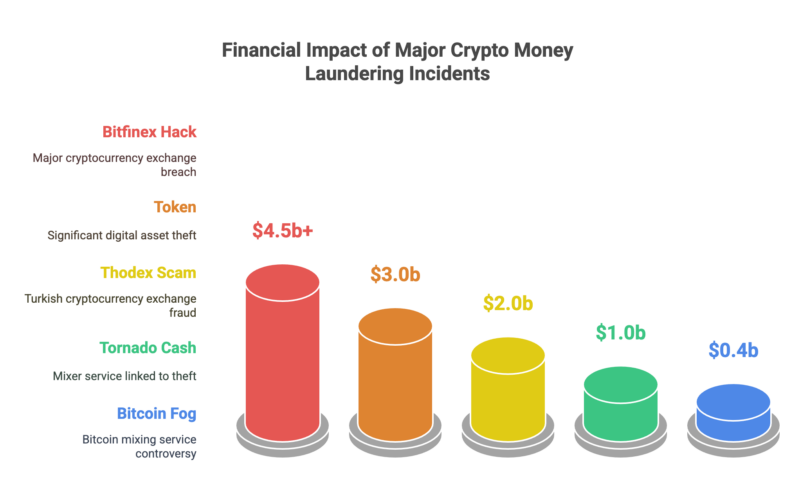
One of the largest cryptocurrency hacks occurred when the Bitfinex exchange was compromised in August 2016, with 120,000 Bitcoin worth billions of dollars (at current valuation) stolen.
In 2022, the US Department of Justice arrested Ilya Lichtenstein and Heather Morgan for conspiracy to launder $4.5 billion in stolen tokens.
How the Prosecution Was Built
Investigators traced funds through what the DOJ described as a “labyrinth of transactions” involving multiple exchanges, false identities, and chain hopping.
The breakthrough came through blockchain analysis combined with traditional techniques which linked online accounts to real identities through operational security failures.
Defence Considerations
The case highlights how, thanks to thorough crypto fraud investigation, even the most sophisticated of laundering attempts can unravel through only minor operational errors.
For defence teams, this underscores the importance of examining exactly how identification was established. Was blockchain analysis alone sufficient, or did prosecutors rely on circumstantial links?
In UK proceedings, the methodology behind wallet attribution may be subject to challenge where assumptions have been made rather than direct evidence obtained.
POCA Relevance
Similar UK cases would engage POCA provisions for restraint and confiscation. The valuation of Bitcoin at the time of offence versus confiscation proceedings presents significant complexity and is a recurring issue in crypto-related POCA matters.
2) Plus Token (2019)
The Plus Token scheme targeted investors in China and Korea, promising returns of 9-18% through what prosecutors alleged was fraud.
When the scheme collapsed in 2019, approximately $3 billion in Bitcoin had been collected. Over 100 individuals were arrested, with principal defendants receiving up to 11 years.
How the Prosecution Was Built
Chinese authorities traced fund flows across the blockchain to identify the network involved. The number of arrests indicates prosecutors cast a wide net.
Defence Considerations
Large-scale prosecutions raise questions about individual culpability. Not everyone associated with a scheme possesses the knowledge or intent required for criminal liability.
Defence teams should scrutinise evidence of each defendant’s specific knowledge. This is particularly relevant where individuals believed they were participating legitimately, or were themselves victims who recruited others in good faith.
For those accused of promoting such schemes, the distinction between criminal fraud and civil mis-selling may be significant.
Expert forensic accounting can help establish what a defendant knew, when, and whether their conduct meets the criminal threshold.
3) Thodex (2021)
Turkey’s Thodex exchange shut down abruptly in April 2021, locking out approximately 400,000 users.
CEO Faruk Fatih Özer allegedly absconded with $2 billion. Following an international manhunt, he was extradited and sentenced to over 11,000 years in prison in 2024.
How the Prosecution Was Built
Prosecutors established the collapse was intentional, tracing fund movements away from user accounts and demonstrating withdrawals were disabled while assets transferred to wallets controlled by Özer.
Defence Considerations
Exchange collapses present complex questions of intent. Not every failed business is fraudulent.
Market volatility, hacking, and mismanagement can cause catastrophic losses without criminal intent. Defence teams must be able to accurately distinguish between evidence of fraud and evidence of incompetence.
In less clear-cut scenarios, forensic accounting examines timing, communications, and financial health prior to collapse, in order to establish whether conduct was fraudulent or merely negligent.
4) Tornado Cash (2023)
Tornado Cash is a mixing service allowing users to obscure transaction trails.
In August 2023, the DOJ charged co-founders Roman Storm and Roman Semenov with money laundering, alleging they knowingly facilitated over $1 billion in illicit transactions.
How the Prosecution Was Built
The case rests on proving the defendants knew their service was used for criminal purposes and continued regardless. Evidence allegedly includes internal communications and awareness that sanctioned entities were using the platform.
Defence Considerations
This case raises profound questions about developer liability for how others use their software.
The defence argues Tornado Cash is neutral technology — analogous to privacy tools used by legitimate users. Developers cannot control who uses open-source code.
For UK solicitors, this signals increasing willingness to pursue those who build infrastructure facilitating crime, even without direct participation in any actual offences.
Defendants in similar cases need expert analysis of what they knew, when, and whether their conduct crosses the line between legitimate service and criminal facilitation.
Expert Support for Cryptocurrency Defence
If you’re advising a client facing cryptocurrency charges, early instruction of a forensic accountant can improve the outcome.
Rob Miller, director of Inquesta Forensic and a Certified Cryptocurrency Investigator, provides expert support to criminal defence solicitors across England and Wales.
For a confidential discussion about your case, contact Rob directly on 0161 243 0595.
5) Silk Road (2013)
Silk Road operated as a dark web marketplace facilitating illegal transactions using Bitcoin. At its peak, the platform reportedly accounted for over 20% of Bitcoin’s daily trading volume.
Founder Ross Ulbricht was arrested in 2013 and convicted of money laundering, hacking, and conspiracy to traffic narcotics, receiving a double life sentence plus forty years.
How the Prosecution Was Built
Despite assumed anonymity, investigators traced transactions and linked the “Dread Pirate Roberts” persona to Ulbricht through blockchain analysis, forum posts, server records, and surveillance.
Defence Considerations
The case demonstrated early assumptions about cryptocurrency anonymity were overstated. Analysis has become far more sophisticated since.
However, the case also illustrates the importance of scrutinising how evidence was obtained. Ulbricht’s defence raised questions about integrity and misconduct — two investigating agents were later convicted of stealing Bitcoin during the investigation.
Defence teams should never assume prosecution evidence is beyond challenge.
POCA Relevance
The seizure involved significant assets. Bitcoin volatility between seizure and confiscation can dramatically affect sums involved — an area requiring forensic accounting expertise.
6) Bitcoin Fog (2021)
Bitcoin Fog operated as a mixing service from 2011 to 2021, allegedly processing $400 million in transactions.
In March 2024, alleged operator Roman Sterlingov was convicted of money laundering.
How the Prosecution Was Built
The prosecution relied heavily on blockchain analysis to connect Sterlingov to the service.
However, the case is notable for defence challenges to reliability. Sterlingov’s team argued the tracing methodology was flawed and didn’t definitively establish his operation of the service.
Defence Considerations
Bitcoin Fog demonstrates blockchain analysis is not infallible. The defence engaged experts to challenge methodology, an approach that should be standard in any case relying on transaction tracing.
Key questions: What assumptions underpin the analysis? Has methodology been validated? Are there alternative explanations?
A forensic accountant experienced in crypto can identify weaknesses that may not be apparent to solicitors unfamiliar with technical details.
POCA Relevance
Benefit calculations for mixing service operators are highly complex. Does the defendant benefit from full value of mixed funds, or only fees charged?
Expert input on benefit calculations can significantly affect confiscation outcomes.

Cryptocurrency and POCA: The Defence Perspective
POCA 2002 classifies cryptocurrency as property. This means digital assets can be subject to restraint orders, confiscation orders, and civil recovery proceedings.
For defence solicitors, three areas demand particular attention: restraint applications, confiscation valuation, and challenging the prosecution’s blockchain analysis.
- Restraint Orders: Can freeze assets during investigation, preventing access for living expenses or legal fees. The threshold is low. Early forensic accountant instruction helps identify assets legitimately excluded from restraint.
- Confiscation and Valuation: Crypto volatility means timing dramatically affects figures. A defendant who received Bitcoin in 2015 may face benefit calculated at current prices — potentially hundreds of times higher. Expert input on valuation methodology can be decisive.
- Challenging Analysis: Blockchain analysis involves assumptions that may not withstand scrutiny. How was ownership established? What methodology linked transactions to the defendant? Are there alternatives? A specialist can identify weaknesses strengthening the defence position.
The Evolving Landscape of Crypto Prosecutions
The crypto prosecution landscape is shifting. Stablecoins dominating illicit flows, cross-border evidence challenges, advancing forensic tools, and regulatory fragmentation all affect how cases are built and defended.
Defence teams should understand each:
- Stablecoins: Stablecoins now account for 84% of all illicit crypto transaction volume. Prosecutions increasingly involve Tether (USDT) rather than Bitcoin, leaving different evidential footprints that defence teams must understand
- Cross-border Complexity: Evidence gathered across jurisdictions creates opportunities; cooperation may be incomplete and overseas material subject to admissibility challenges
- Advancing Capabilities: Blockchain analysis tools are more sophisticated; assume prosecution evidence will be more detailed than earlier cases
- Regulatory Divergence: Different jurisdictions taking different approaches. This may affect how courts view defendant’s understanding of obligations

-
Common Crypto Money Laundering Questions
Q: How do prosecutors trace cryptocurrency transactions? A: Prosecutors use blockchain analysis software to trace transaction flows across public ledgers, combining this with traditional techniques to link wallet addresses to real identities through exchange records, IP addresses, and operational security failures.
Q: Can blockchain analysis be challenged in court? A: Yes. Blockchain analysis relies on assumptions about wallet ownership and transaction patterns that may not withstand scrutiny. Defence teams can challenge methodology, question how identification was established, and present alternative explanations.
Q: How does POCA apply to cryptocurrency? A: POCA 2002 classifies cryptocurrency as property. Digital assets can be subject to restraint orders during investigation and confiscation orders following conviction. Valuation timing is particularly significant given market volatility.
Q: When should I instruct a forensic accountant for a crypto case? A: As early as possible. Early instruction allows review of prosecution evidence, identification of methodology weaknesses, challenge to restraint applications, and preparation of robust defence analysis.
Q: What makes crypto confiscation cases complex? A: Extreme price volatility between offence and confiscation dramatically affects benefit figures. Questions also arise about what constitutes “benefit” — for mixing services, is it the full value processed or only fees charged?

Forensic Accountant Support for Cryptocurrency Defence
Cryptocurrency prosecutions demand expert analysis; not just of transaction flows, but of methodology and assumptions.
Instructing a forensic accountant who understands both financial and technical aspects can improve outcomes.
Rob Miller, director of Inquesta Forensic and a Certified Cryptocurrency Investigator, provides expert support to criminal defence solicitors across England and Wales.
Unlike larger firms, Rob handles all matters personally, from initial review through to expert witness testimony. His direct involvement means a more personal service, consistent analysis, and the assistance of an expert who knows your case intimately when it matters in court.
Rob’s cryptocurrency defence work includes:
- Reviewing prosecution blockchain analysis and identifying methodology weaknesses.
- Analysing transaction flows to challenge POCA benefit calculations.
- Providing expert opinion on cryptocurrency valuation disputes.
- Preparing court-ready forensic accounting reports.
- Giving expert witness testimony in trials and confiscation hearings.
For a confidential discussion, fill in our contact form to request a callback, or get in touch with Rob directly on 0161 243 0595.